I don't know about you, but summer for me has been a time to do many different types of things. I took 2 online classes (very cool!), taught some music lessons, swam, worked on a book, played computer Scrabble, wrote some e-mails about improving our school, connected with some school families, took a trip, and generally spaced out my obligations so they weren't making me crazy.
Of course, I'm a teacher, so I get to do that. I apologize to the people with year-round jobs- imagine your years as a student , perhaps.
I recently read a book about Results Only Work Environment (Why Work Sucks and and How To Fix It). It is about people at Best Buy and their efforts to do work differently- to use results rather than time, to delete nonproductive meetings, and to "make every day seem like Saturday".
I am going to aim at doing this at my school this year. I would like to be emphasizing work and not time, and I'm hoping for a "learning explosion" (or at least wishing for it! :) In order to do this I think I will work on helping students design better and better projects- things they really want to learn about. I will use Google Docs so I can "look in" on their work. And I will try to free myself somewhat from the thought that my presence is necessary for them to do work. If I look at outcomes more, I'm hoping that they will pay more attention to them also.
Wish me luck! If you want to discuss these ideas, please write back!
Friday, August 01, 2008


Thursday, December 27, 2007
What we learn at vacation time
I am sad that most kids, even in my "alternative" school, were eagerly looking forward to vacation from school. They cited things like sleeping in, hanging out, and getting presents, as reasons for this phenomenon.
I would like to be working in a school where kids were comfortable, where the schedule would fit around their needs. When I was homeschooling and bringing my kids to "Twin Cities Unschool" (now extinct), they eagerly looked forward to going there and seeing their friends. I know most kids in truly democratic schools like Sudbury Valley School actually don't like vacations, because they view it as deprivation from seeing their friends and having fun!
I have toyed with starting a democratic school in Minnesota. Maybe I would like to do that someday. I once tried to start a charter school like that here, but, being publicly funded, the potential sponsors were all for testing and measuring "growth" as if all kids "grow" at the same rates (or should do that, at any rate). I refused to set our school up for failure by trying to attain some measurement like that, so the school didn't happen. I wonder if I made the right decision?
I know there are schools that have since found ways around the testing-as-God ideals they were asking of us. But I also know of schools that closed or changed significantly after they agreed to "measure growth" this way.
I hope someday to see what I can do in this arena. For now, I'm enjoying my own vacation, writing my book and my blog, taking time to breathe that I don't have on normal school days. I'll see what I can do about scheduling breathing time then too! :)
I would like to be working in a school where kids were comfortable, where the schedule would fit around their needs. When I was homeschooling and bringing my kids to "Twin Cities Unschool" (now extinct), they eagerly looked forward to going there and seeing their friends. I know most kids in truly democratic schools like Sudbury Valley School actually don't like vacations, because they view it as deprivation from seeing their friends and having fun!
I have toyed with starting a democratic school in Minnesota. Maybe I would like to do that someday. I once tried to start a charter school like that here, but, being publicly funded, the potential sponsors were all for testing and measuring "growth" as if all kids "grow" at the same rates (or should do that, at any rate). I refused to set our school up for failure by trying to attain some measurement like that, so the school didn't happen. I wonder if I made the right decision?
I know there are schools that have since found ways around the testing-as-God ideals they were asking of us. But I also know of schools that closed or changed significantly after they agreed to "measure growth" this way.
I hope someday to see what I can do in this arena. For now, I'm enjoying my own vacation, writing my book and my blog, taking time to breathe that I don't have on normal school days. I'll see what I can do about scheduling breathing time then too! :)
Monday, October 15, 2007
Environmental Blogging day
Today is blog action day, to talk about environment. I feel pretty sad about the environmental spiral we are in as a globe. Here are my contributions, plus and minus:
+
I work online, so I don't commute
I turn off things when not using them
I am considering moving someplace so nobody in the house would need to commute
I use conserving lightbulbs (at least I've started)
I contribute to Sierra Club monthly
I help students who are interested in environment to do projects on the topic and learn more
I recycle
I drive a Civic
I write e-mails in support of environmental causes
-
I own a pool and use chemicals!
House insulation needs work, as do windows
Our house is too big for the number of people who live here, so I should downsize
I'm not very active in environmental causes, and I don't concentrate on this field very well
What are your contributions? Maybe you could give me some ideas!
+
I work online, so I don't commute
I turn off things when not using them
I am considering moving someplace so nobody in the house would need to commute
I use conserving lightbulbs (at least I've started)
I contribute to Sierra Club monthly
I help students who are interested in environment to do projects on the topic and learn more
I recycle
I drive a Civic
I write e-mails in support of environmental causes
-
I own a pool and use chemicals!
House insulation needs work, as do windows
Our house is too big for the number of people who live here, so I should downsize
I'm not very active in environmental causes, and I don't concentrate on this field very well
What are your contributions? Maybe you could give me some ideas!
Monday, July 30, 2007
Learning What's Important
This summer I'm learning lots of things- how to write a book (get up and write first thing, for me- that's when I'm freshest), how to lift weights (girls didn't do this when I was young), and how to pace myself and mix fun things with "must do" things. Kids learn lots in the summer too, about friendship, and relaxation, and work relationships, and Harry Potter/magic/growing up and seeing adults as fallable (all involved in the last Harry Potter book).
Now compare those lessons with the ones we'll learn this year in school- about the capital of Bosnia, or the formula for the surface area of a sphere, and how to write a research paper with the right kind of footnotes.
Which ones are lifelong lessons? Which ones get our attention and keep it? Why are schools not about real learning?
Just imagine unleashing the creativity and knowhow of our teachers and students on real problems around them. Making their city safer, helping poor people to earn more money, dealing with the drug problem.
This year I will help students (and myself) find and help solve real problems. I think this is a worthy goal, and one that will help to improve the world around me.
Now compare those lessons with the ones we'll learn this year in school- about the capital of Bosnia, or the formula for the surface area of a sphere, and how to write a research paper with the right kind of footnotes.
Which ones are lifelong lessons? Which ones get our attention and keep it? Why are schools not about real learning?
Just imagine unleashing the creativity and knowhow of our teachers and students on real problems around them. Making their city safer, helping poor people to earn more money, dealing with the drug problem.
This year I will help students (and myself) find and help solve real problems. I think this is a worthy goal, and one that will help to improve the world around me.
Saturday, November 25, 2006
Education in the Old and New World
The pre-computer world and the post-computer world obviously need very different skills. This has meant that education itself has been split wide open, leading to much confusion and difficulty in setting and achieving goals. If the very definition of knowledge has changed, then how can we best educate someone? Do we decide what facts students should learn, teach those facts, and then test to see how we've done? Or should we help students to set their own learning goals, train them to find the information they need, and then help them demonstrate their learning? These are very, very different objectives. And yet, if you look carefully into school districts, school buildings, and even within individual classrooms you'll find a kind of schizophrenic attempt at doing bits of both of these things, with very disheartening results. When one sets off on a trip and then changes direction every 100 feet, one isn't likely to arrive at a desirable destination, or indeed travel very far at all.
Pre-computer education was built on several fallacies. First, there was an assembly-line mentality that all students are alike, that all can do the same things, that all SHOULD do the same things. This makes little sense as the world gets more and more specialized, but it is now being enforced as never before through all the standardized tests included in the No Child Left Behind laws. Another fallacy is that there is an orderly and predictable route that learning happens in. Thus "pre-reading" skills are religiously taught, regardless of the fact that millions of children (including my own) learn to read without ever having been taught them. A third fallacy is that if one simply memorizes enough things they'll succeed in the world. In reality, more people are fired from jobs for not being able to work with other people (something left out the NCLB altogether) than for not having some kind of knowledge of facts. Last but not least, there is a belief that somewhere, some collection of people knows exactly what everyone in the country should know, so there is a way to design a test that will measure if one is an "educated person". When Minnesota held hearings on the Social Studies curriculum this assumption was thoroughly tested, as the extremely long list of competencies that had been designed by the "experts" was shown to be extremely biased- and also, it had nothing in it about knowing about current political issues, how to choose candidates, or even the basic skills about how to vote! Each curriculum area is like this- there is much controversy, even among experts in different fields, about what comprise the basic knowledge in each area.
Post- computer education would be entirely different, and as such it is difficult to even imagine how it would look. For one thing, emphasizing the skills of finding information rather than memorizing it presents the possibility that students get to decide what to research. Also, since students often know more about the Internet than their teachers, there would be more of a collegial atmosphere than a dictatorial one, where teachers help pose questions or problems and then all parties do some investigation, sharing their findings equally. This goes for hardware and software too- those of us who've worked in schools already know that the techie kids are a necessary component of our school's computer department, and they often know more than the people hired to supervise them. Demonstrating learning won't be done through testing, since everyone will be learning about different topics. So instead there will be student presentations, powerpoints, essays, even books or movies that show the meaningful things (to them and hopefully to others) that they have investigated. These can be shared with others inside the school, but also to the outside community via websites or real-time presentations in person or online. Rather than going on to more generalized training such as college, more students will choose to specialize from the start, and they may either launch their own business or go to specialized schools or online classes to learn just what they need to know to take the next step in their chosen field, whether it be hair design, international negotiations, or quantum physics.
In schools today there are trends toward both worlds. The pre-computer direction is yielding standardized curricula (most textbook companies are now advertising that they are "standards based", meaning that they'll teach to the tests), and teachers, schools and districts are being let go or taken over if their students' test scores aren't high enough. This is actually leading to more "throw-away kids", because the districts don't mind if low-achieving kids drop out, since those are the very ones who lower the district's test scores. Even community colleges for hands-on training such as carpentry or cooking are requiring students to pass tests in order to get in. At the same time, some schools or teachers are asking for creativity and original research projects, assuming that this new world will require all the adaptability their students can come up with. Service learning is also a hot topic right now, requiring that students go out in the community and exhibit people skills which the schools have totally ignored up to that point. And alternatives such as charter schools are showing that parents and students really crave the more humane, individualized education that we've lost through all the years of standardization.
We need to begin discussing these conflicting aims, trying to come up with some understanding about how the 2 worlds can cooperate with each other, both for the sake of the children, but also for the sake of the world we're launching them into. Instead of retreating into our separate corners, let's talk about how we can create forums and find some common goals. I'll work on this in coming months.
What are symptoms you see of these splits? Have you seen these cross-era forums happening? If so, where and how?
Thursday, November 23, 2006
Clash of 2 Worlds
It seems to me we’re seeing a clash of 2 worlds:
the pre-computer world, where we must know everything, and
the post-computer world, where we must know where to find everything.
In the pre- world things were orderly. Some students/people were smart; they could memorize lots of things and spit them back on cue. There was an orderly path to the good life- students went to a school (good school= the most memorization available), aced college tests and got into good colleges (ditto good college), and thenthey found a job in some field that honored the knowledge they had, even if it didn’t actually USE it (how many people use their learning in their day-to-day life?). Kids who weren’t so smart, or weren’t in an environment that honored those smarts or could get them into “good” schools, went down different roads, either into not-so-good schools and jobs, or into the trade or business worlds, feeling inferior even if they made lots of money.
In the post-world students/people are honored for their individual interests and skills. If you can design a website/software/product, and if people want your skills, then you’re paid accordingly. Discovery and innovation matter more than memorization. Knowing how and where to find answers matters more than knowing the answers themselves. And actually, you might be helping the world to adjust what it “knows”. You might be one of the hundreds of thousands of people who have now become authors themselves, helping to educate and keep the world informed on sites like Wikipedia, Wiktionary, or even personal blogs which are visited by thousands of people
Unfortunately, these worlds often don’t coexist very happily. People who’ve been successful in the pre- world sometimes feel left-behind and powerless in the new world. It’s even possible that they’re trying to fight back, though unconsciously. Have you ever wondered why our country is ordering more and more testing just when we have less and less need to memorize facts? Why there’s such fanaticism for math and science just when we desperately need people who know how to negotiate, understand our “enemies”, and solve so many social and environmental problems? Could it be attempts by “pre-“ elite to maintain their hold on students/people? Students won’t have time to innovate and explore new technologies if we keep making them memorize more and more ……stuff! Unfortunately, they also won’t have time to help us solve problems of poverty, environmental woes, or other challenges either.
The post- people have their own ways to fight back. The most obvious ways are creating viruses and worms. How many people who make these things are just angry at how the pre- world has treated them? Their skills were often not honored or rewarded; their contributions were ignored until they invaded our own small computer worlds. Another retributive act is music and document/book sharing (or stealing, depending on how you look at it) . Post- people sometimes don't honor the intellectual property rights that have been taken for granted for centuries, partly because they've grown up in such a free atmosphere that gates around certain information seem ridiculous. They also may look down on Pre- people simply because they don't understand newer terms and procedures.
These 2 different ways of looking at the world are affecting education in a big way. In the next entry I’ll be looking at how education fits into this war, how teachers and students are being pulled more and more toward both of these poles at the same time.
the pre-computer world, where we must know everything, and
the post-computer world, where we must know where to find everything.
In the pre- world things were orderly. Some students/people were smart; they could memorize lots of things and spit them back on cue. There was an orderly path to the good life- students went to a school (good school= the most memorization available), aced college tests and got into good colleges (ditto good college), and thenthey found a job in some field that honored the knowledge they had, even if it didn’t actually USE it (how many people use their learning in their day-to-day life?). Kids who weren’t so smart, or weren’t in an environment that honored those smarts or could get them into “good” schools, went down different roads, either into not-so-good schools and jobs, or into the trade or business worlds, feeling inferior even if they made lots of money.
In the post-world students/people are honored for their individual interests and skills. If you can design a website/software/product, and if people want your skills, then you’re paid accordingly. Discovery and innovation matter more than memorization. Knowing how and where to find answers matters more than knowing the answers themselves. And actually, you might be helping the world to adjust what it “knows”. You might be one of the hundreds of thousands of people who have now become authors themselves, helping to educate and keep the world informed on sites like Wikipedia, Wiktionary, or even personal blogs which are visited by thousands of people
Unfortunately, these worlds often don’t coexist very happily. People who’ve been successful in the pre- world sometimes feel left-behind and powerless in the new world. It’s even possible that they’re trying to fight back, though unconsciously. Have you ever wondered why our country is ordering more and more testing just when we have less and less need to memorize facts? Why there’s such fanaticism for math and science just when we desperately need people who know how to negotiate, understand our “enemies”, and solve so many social and environmental problems? Could it be attempts by “pre-“ elite to maintain their hold on students/people? Students won’t have time to innovate and explore new technologies if we keep making them memorize more and more ……stuff! Unfortunately, they also won’t have time to help us solve problems of poverty, environmental woes, or other challenges either.
The post- people have their own ways to fight back. The most obvious ways are creating viruses and worms. How many people who make these things are just angry at how the pre- world has treated them? Their skills were often not honored or rewarded; their contributions were ignored until they invaded our own small computer worlds. Another retributive act is music and document/book sharing (or stealing, depending on how you look at it) . Post- people sometimes don't honor the intellectual property rights that have been taken for granted for centuries, partly because they've grown up in such a free atmosphere that gates around certain information seem ridiculous. They also may look down on Pre- people simply because they don't understand newer terms and procedures.
These 2 different ways of looking at the world are affecting education in a big way. In the next entry I’ll be looking at how education fits into this war, how teachers and students are being pulled more and more toward both of these poles at the same time.
Sunday, September 10, 2006
What did you learn today?
Parents often ask this of their children, and children are expected to (but rarely can or want to) list some facts or topics that they were "taught". Things like the capitol of Ethiopia, or the year the Civil War started, or the square root of 144.
I spent part of Friday morning reassuring a student that he was, indeed, learning even thought he didn't list any "facts" he had studied that day. In fact, it was a momentous day for him, as he was preparing for a performance with a band and by himself that night, and then he was training in for a new facet of his job at work.
Who in their right mind would say he wasn't learning anything doing those things? Just a short list includes: practicing fingerings/songs on guitar, calling others to make sure everything was prepared, planning what to wear, figuring out how to not be too nervous but to be "pumped up", feeling the experience of playing solo on a stage, keeping one's mind on songs and not on audience distractions, learning how to decompress after a performance, finding ways to go to sleep with adrenaline rushing to be rested for work the next day....and on and on. (As you may have guessed, I've done some performing too:)
And yet, this person was worried about not learning enough! Our system, it seems, has brainwashed us into believing that only sitting in a classroom is educational, only things on tests are important lessons, and all of it has to be incredibly boring.
Hopefully he'll relax and realize how educational his life really is.
Hopefully we all will!
Shalom
I spent part of Friday morning reassuring a student that he was, indeed, learning even thought he didn't list any "facts" he had studied that day. In fact, it was a momentous day for him, as he was preparing for a performance with a band and by himself that night, and then he was training in for a new facet of his job at work.
Who in their right mind would say he wasn't learning anything doing those things? Just a short list includes: practicing fingerings/songs on guitar, calling others to make sure everything was prepared, planning what to wear, figuring out how to not be too nervous but to be "pumped up", feeling the experience of playing solo on a stage, keeping one's mind on songs and not on audience distractions, learning how to decompress after a performance, finding ways to go to sleep with adrenaline rushing to be rested for work the next day....and on and on. (As you may have guessed, I've done some performing too:)
And yet, this person was worried about not learning enough! Our system, it seems, has brainwashed us into believing that only sitting in a classroom is educational, only things on tests are important lessons, and all of it has to be incredibly boring.
Hopefully he'll relax and realize how educational his life really is.
Hopefully we all will!
Shalom
Thursday, September 07, 2006
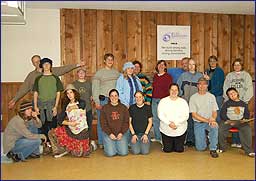

Welcome to Education On The Edge!
Job: advisor (i.e. teacher) at an online, project-based school.
My School: EdVisions Off-Campus High School, in Minnesota
School Website: www.eochs.k12.mn.us
Welcome to my blog. I'm very new at this, so I'll probably make lots of mistakes- but hey, we're all new at something! Since I work at an online school I'm trying to learn about this new way to communicate. I've had a personal computer since 1982 (not the same one, obviously!).....but don't tell the tech person at my school- you certainly wouldn't know it by my ...er..computer skills.
About 15 years ago I made a very unusual decision for a teacher: I decided to never teach anyone anything they didn't want to know. I was sick of fighting to "get information in" to students who- didn't want it, wouldn't remember it, and would never need to remember it. It just didn't make sense anymore. I wanted to help create "win win" situations where the kids and I were on the same side, where we didn't struggle against each other and I didn't feel like a policewoman.
Since then it's been interesting. Some of the things I've done:
-homeschooled- helping my kids learn things they were interested in
-taught music lessons-teaching little 5th graders how to play the trumpet or drums is a kick :)
-taught classes at the local park- from preschool music to piano lessons to summer daycare
-done a little tutoring to help raise kids' basic skills (I quit this when it became apparent that most of the time they weren't interested in MORE work on reading, math...)
-taught summer community ed classes such as: Bubbles and Goo for little kids, Harry Potter classes, music classes, etc.
5 years ago I started working in charter schools here. I worked at Minnesota New Country School, a project-based school where students designed projects, carried them out, and then got credit for their learning. Then last year our online school started. It's a blast!
Topics to expect here: alternative education, democratic education, project-based education, online learning, personally tailored education, homeschooling, psychosynthesis, subpersonalities, nonviolent communcation, body-centered psychology.
Invitation to join the conversations: I'm excited about "meeting" you all- learning what else is out there!
Kids and adults are all invited to join in the conversation!
Karen Locke
My School: EdVisions Off-Campus High School, in Minnesota
School Website: www.eochs.k12.mn.us
Welcome to my blog. I'm very new at this, so I'll probably make lots of mistakes- but hey, we're all new at something! Since I work at an online school I'm trying to learn about this new way to communicate. I've had a personal computer since 1982 (not the same one, obviously!).....but don't tell the tech person at my school- you certainly wouldn't know it by my ...er..computer skills.
About 15 years ago I made a very unusual decision for a teacher: I decided to never teach anyone anything they didn't want to know. I was sick of fighting to "get information in" to students who- didn't want it, wouldn't remember it, and would never need to remember it. It just didn't make sense anymore. I wanted to help create "win win" situations where the kids and I were on the same side, where we didn't struggle against each other and I didn't feel like a policewoman.
Since then it's been interesting. Some of the things I've done:
-homeschooled- helping my kids learn things they were interested in
-taught music lessons-teaching little 5th graders how to play the trumpet or drums is a kick :)
-taught classes at the local park- from preschool music to piano lessons to summer daycare
-done a little tutoring to help raise kids' basic skills (I quit this when it became apparent that most of the time they weren't interested in MORE work on reading, math...)
-taught summer community ed classes such as: Bubbles and Goo for little kids, Harry Potter classes, music classes, etc.
5 years ago I started working in charter schools here. I worked at Minnesota New Country School, a project-based school where students designed projects, carried them out, and then got credit for their learning. Then last year our online school started. It's a blast!
Topics to expect here: alternative education, democratic education, project-based education, online learning, personally tailored education, homeschooling, psychosynthesis, subpersonalities, nonviolent communcation, body-centered psychology.
Invitation to join the conversations: I'm excited about "meeting" you all- learning what else is out there!
Kids and adults are all invited to join in the conversation!
Karen Locke
Subscribe to:
Posts (Atom)